Understanding Real-Time PO Status Tracking – Creating Visibility Across Your Business
Part 2: What Makes This Actually Work
The Foundation: Data Capture at Every Stage
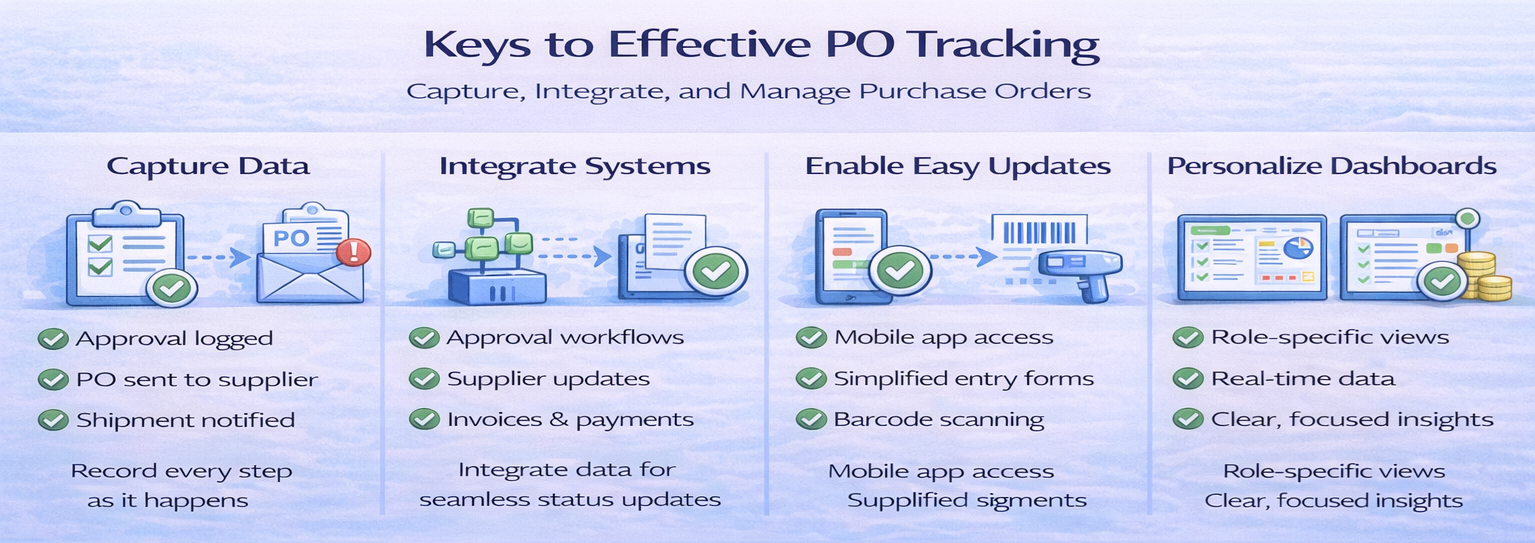
Status tracking only works if data is captured when things happen:
- Approval: System logs when someone approves (automatic if digital)
- PO sent: System logs when sent to supplier (automatic if electronic)
- Acknowledgment: Need supplier to confirm (integration or portal)
- Shipping: Need supplier notification (integration or manual entry)
- Receipt: Need receiving team to log (barcode scan or system entry)
- Invoice: Need invoice capture (OCR or manual)
If any stage isn’t captured, you have a blind spot.
The Integration Requirements:
To provide complete visibility, you need to pull data from:
- Your approval workflow system
- Your PO generation system
- Supplier communications (email, EDI, portal)
- Shipping systems (courier APIs)
- Your receiving/inventory system
- Your AP/invoice system
- Your payment system
The more integrated these are, the more automatic the status updates. The less integrated, the more manual updating required.
The Manual Entry Problem:
Some status updates will require human input:
- Small suppliers without system integration
- Shipping from suppliers without tracking
- Quality issues during receiving
- Special circumstances
You need to make manual status updates easy:
- Mobile app for receiving team
- Quick update forms
- Barcode scanning
- Email-triggered updates
If it’s hard to update, people won’t do it consistently.
Ready to let AI protect your procurement?
Contact Systematics Software Ltd today to explore how AI-powered solutions can revolutionise your operations and prepare you for the future of technology.
Nam aliquet ante porta, gravida elit, at fringilla felis suscipit.
Understanding Dashboard Design:
Different people need different views:
Requestor View:
- My requests and their status
- Expected delivery dates
- What needs my attention
- Historical orders for reference
Approver View:
- What needs my approval (priority sorted)
- What I’ve approved recently
- What’s overdue for my action
- My approval performance metrics
Finance View:
- All active POs and their commitment value
- Budget consumed vs available
- Invoices awaiting matching
- Payment schedule
- Discrepancy report
Procurement View:
- All active POs across the business
- Supplier performance metrics
- Late deliveries
- Exception queue
- Volume and spending trends
Executive View:
- High-level metrics
- Budget utilisation
- Process performance
- Risk indicators
- Trends over time
The Real-Time Challenge:
“Real-time” sounds straightforward but has practical implications:
True real-time: Updates appear instantly when events happen. Requires event-driven architecture, system integration, and higher technical complexity.
Near real-time: Updates appear within minutes. Often good enough. Batch processing every 5-15 minutes.
Periodic updates: Updates happen on a schedule (hourly, daily). Simpler to implement but less responsive.
For most businesses, near real-time (5-10 minute lag) is the sweet spot – responsive enough to be useful, simple enough to implement reliably.
The Mobile Consideration:
People aren’t always at desks:
- Approvers might be traveling
- Receiving team is in the warehouse
- Managers are in meetings
- Executives are mobile
Mobile access isn’t optional:
- Responsive web design minimum
- Native apps better for frequent users
- Push notifications for time-sensitive items
- Offline capability for poor connectivity areas
Understanding Alert Fatigue:
Too many notifications = ignored notifications. Balance is critical:
High Priority (Immediate alert):
- Approval needed for urgent/high-value PO
- Critical delay on important order
- Compliance issue detected
Medium Priority (Daily digest):
- Routine approvals
- Expected status updates
- Non-critical delays
Low Priority (Weekly summary or on-demand):
- Completed orders
- Routine metrics
- Historical trends
Ready to deploy AI protection across your procurement?
Contact Systematics Software Ltd today to explore how AI-powered solutions can revolutionise your operations and prepare you for the future of technology.
Nam aliquet ante porta, gravida elit, at fringilla felis suscipit.
The Exception Management Reality:
Not everything goes smoothly:
- Suppliers delay shipments
- Quantities don’t match
- Quality issues arise
- Prices change
- Urgency increases
Your status tracking needs exception workflows:
- How to flag an exception
- Who handles different exception types
- Escalation if not resolved
- Communication with stakeholders
- Resolution tracking
The Supplier Portal Question:
Should suppliers have access to see their POs and status?
Benefits:
- Reduces “did you send us a PO?” calls
- Suppliers can update status themselves
- Better communication
- More professional relationship
Challenges:
- Another system for suppliers to access
- Security and access control
- Not all suppliers will use it
- Maintenance overhead
Many businesses find that focusing on top 20% of suppliers (by volume) for portal access, while handling the rest via email, provides the best balance.
Measuring What Matters:
Track metrics that drive improvement:
- Average time per stage: Where are the bottlenecks?
- On-time delivery rate: Supplier performance
- Approval time by approver: Who’s fast/slow?
- Emergency order rate: Are you planning well?
- Status inquiry volume: Is visibility actually reducing questions?
Use metrics to identify improvement opportunities, not to punish people.
The Change Management Reality:
Transparency can be uncomfortable:
- Slow approvers become visible
- Inefficient processes become obvious
- Problem suppliers get highlighted
- Department spending patterns are clear
Some people resist this transparency. Address it head-on:
- The goal is improvement, not blame
- Data helps identify systemic issues
- Visibility benefits everyone
- Problems hidden are problems that persist
Common Implementation Mistakes:
Tracking too many stages: Don’t track 30 micro-stages. Track 8-12 meaningful milestones. More stages = more data capture burden = less compliance.
Ignoring the receiving team: If the warehouse won’t log receipts, your tracking goes dark at a critical stage. Make their life easier with mobile apps and barcode scanning.
Over-automating notifications: Alert fatigue is real. Start with fewer notifications and add based on feedback, not the other way around.
Not having exception workflows: Perfect process is fantasy. Exception handling is where real life happens. Design for it.
Forgetting about historical data: Status tracking is valuable long-term. Archive completed orders with full status history. The historical data becomes increasingly valuable for analysis.
Questions to Consider:
Before implementing status tracking:
- What percentage of your time is spent answering “where’s my order?” questions?
- Can you currently produce a list of all active POs and their status?
- Do you know average time from request to approval? Approval to delivery?
- Do you have visibility into supplier performance?
- Can you identify your process bottlenecks?
- What systems currently hold pieces of this status information?
If you can’t answer these questions, you’re not alone. Most businesses can’t. But the answers determine whether status tracking will deliver value.
Interested in exploring how status visibility might work in your environment?
Every business has different needs and different existing systems. I’m happy to discuss what I’ve seen work well in different scenarios – no commitment, just a conversation.
Let’s talk: https://calendly.com/jiteshlakhani
Or call: 0207 031 9810