Understanding Real-Time PO Status Tracking – Creating Visibility Across Your Business
Part 1: Why Status Visibility Matters More Than You Think
The Information Black Hole:
In most businesses, purchase orders enter a black hole:
- Someone submits a request
- They get no confirmation
- They don’t know where it is in the approval process
- They don’t know when to expect delivery
- They end up emailing multiple people asking “what’s happening?”
Meanwhile:
- Approvers don’t have a clear list of what needs their attention
- Finance can’t see commitments until they’re fully processed
- Receiving doesn’t know what’s arriving when
- Suppliers are calling asking if POs were received
Everyone wastes time asking and answering status questions.
What Real-Time Tracking Actually Means:
It’s about making the invisible visible. At any moment, anyone with appropriate access can see:
- Where a PO is in the process
- What stage it’s at
- Who’s responsible for the next action
- Expected timeline
- Any blockers or issues
This isn’t magic – it’s just capturing and displaying information that exists but is currently hidden in email threads and people’s heads.
Ready to let AI protect your procurement?
Contact Systematics Software Ltd today to explore how AI-powered solutions can revolutionise your operations and prepare you for the future of technology.
Nam aliquet ante porta, gravida elit, at fringilla felis suscipit.
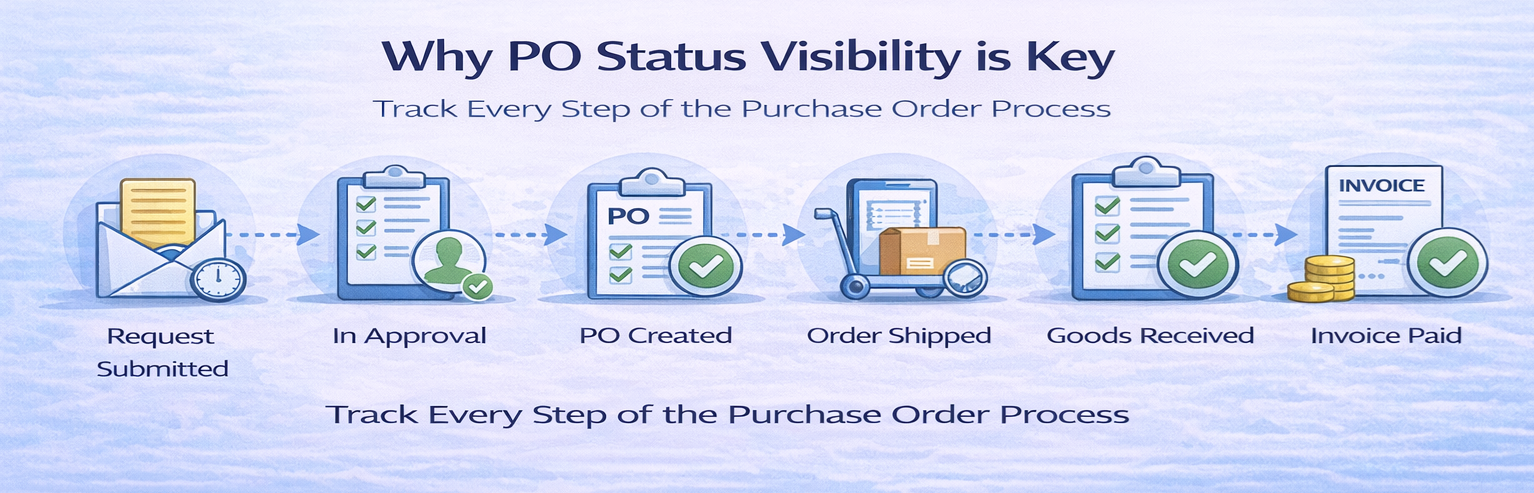
The Stages to Track:
A typical PO lifecycle has distinct stages:
Stage 1: Request Submitted Someone needs to buy something. Request is created. Clock starts ticking.
Stage 2: Approval Process Routing through appropriate approvers based on rules. May be one person, may be several sequentially or in parallel.
Stage 3: PO Created Approvals complete. Formal PO generated and sent to supplier.
Stage 4: Supplier Acknowledgment Supplier confirms they received it and can fulfill it. Commitment established.
Stage 5: Order in Progress Supplier is working on it – manufacturing, picking, preparing shipment.
Stage 6: Shipped Left supplier’s location. In transit. Tracking information available.
Stage 7: Received Arrived at your location. Logged by receiving team.
Stage 8: Quality Check/Put Away Inspected and moved to inventory or delivered to requestor.
Stage 9: Invoice Received Supplier invoice arrives and is processed.
Stage 10: Payment Scheduled Invoice matched and approved. Payment queued.
Stage 11: Paid Payment sent. Transaction complete.
Each business might have slightly different stages, but the principle is the same: clear milestones with clear ownership.
The Notification Challenge:
Information is only useful if people know about it. But nobody wants spam. The balance is:
Proactive Notifications: Tell people when they need to know:
- Action required (you need to approve)
- Status change (your request was approved)
- Expected event (delivery tomorrow)
- Problem detected (delay identified)
On-Demand Information: Make it easy to check:
- Dashboard showing all my requests
- Search by PO number
- Filter by status or date
- Historical record
Preference Control: Let people choose:
- Immediate notifications vs daily digest
- SMS for urgent, email for routine
- Channel preferences (email, Teams, Slack)
- Notification level (everything vs exceptions only)
The Accountability Effect:
Here’s what’s interesting: visibility creates accountability. When everyone can see where things are stuck:
- Approvers act faster (nobody wants to be the bottleneck)
- Issues surface quickly (delays become obvious)
- Performance becomes measurable (average approval time visible)
It’s not about blaming people – it’s about removing excuses and creating clarity.
Understanding Exception Detection:
The system can notice patterns:
- This PO has been with Approver X for 3 days (average is 4 hours)
- Supplier Y acknowledged but hasn’t shipped (expected ship date passed)
- This PO is marked urgent but is proceeding at normal pace
- Delivery was expected yesterday, no receipt logged
These exceptions trigger escalations or notifications, ensuring problems don’t hide.
Ready to deploy AI protection across your procurement?
Contact Systematics Software Ltd today to explore how AI-powered solutions can revolutionise your operations and prepare you for the future of technology.
Nam aliquet ante porta, gravida elit, at fringilla felis suscipit.
The Data Quality Angle:
Status tracking creates timestamp data:
- When submitted
- When approved (by whom)
- When sent to supplier
- When acknowledged
- When shipped
- When received
- When invoiced
- When paid
This complete timeline data is invaluable:
- Process analysis (where are the delays?)
- Performance metrics (how long does each stage take?)
- Supplier benchmarking (who’s consistently fast/slow?)
- Predictive modeling (how long will this order take based on history?)
Good timestamp data is the foundation for AI applications later.
Interested in exploring how status visibility might work in your environment?
Every business has different needs and different existing systems. I’m happy to discuss what I’ve seen work well in different scenarios – no commitment, just a conversation.
Let’s talk: https://calendly.com/jiteshlakhani
Or call: 0207 031 9810