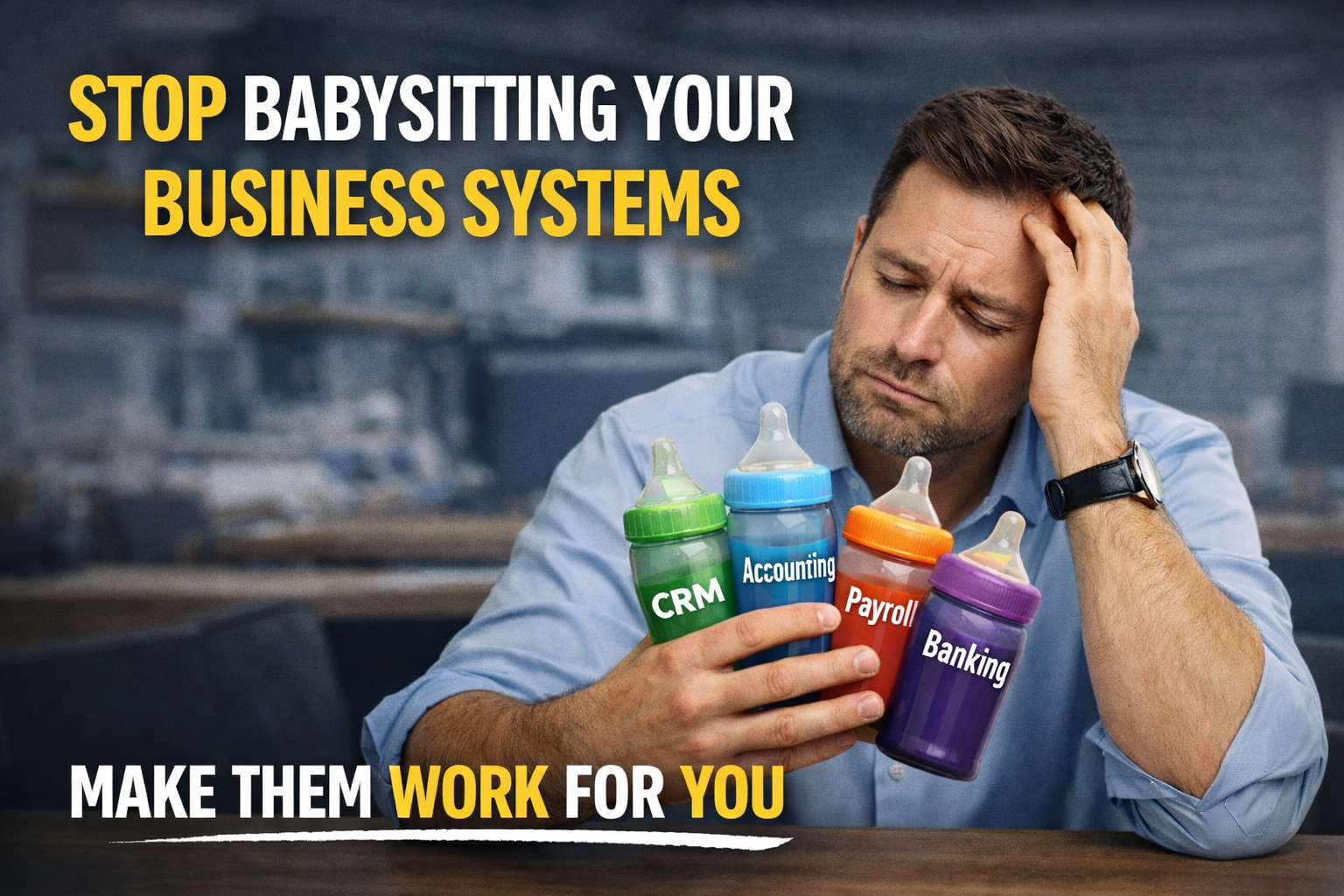
Stop Babysitting Your Business Systems: Make Them Work For You
You Hired Staff to Grow Your Business. They’re Managing Software Instead.
Take a honest look at how your team spends their time.
How much of their day is:
- Moving data between systems
- Checking if information synced correctly
- Chasing people for approvals
- Reconciling mismatched records
- Working around system limitations
Now ask yourself: Is this what you hired them to do?
The Babysitting Tax
Modern businesses run on software. CRM, accounting, payment processing, banking, inventory management, project tracking, marketing automation.
Each system is powerful individually. But they don’t naturally work together.
So someone has to make them work together. Usually multiple someones.
The Morning Routine:
- Check if yesterday’s orders exported to accounting
- Manually enter any that didn’t
- Verify payment system matches banking platform
- Update CRM with payment status
- Flag discrepancies for investigation
The Monthly Close:
- Extract data from five different systems
- Import into spreadsheets
- Manually reconcile differences
- Hunt down missing transactions
- Create reports that should be automatic
The Daily Firefighting:
- “Why does accounting show this customer paid but CRM doesn’t?”
- “Which system has the correct address?”
- “Did this order get invoiced?”
- “Why doesn’t our inventory match the warehouse?”
This is babysitting. Constant supervision to keep systems functioning as they should automatically.
Ready to let AI protect your procurement?
Contact Systematics Software Ltd today to explore how AI-powered solutions can revolutionise your operations and prepare you for the future of technology.
Nam aliquet ante porta, gravida elit, at fringilla felis suscipit.
What This Actually Costs
Direct Labour: For a small business with 10 employees, conservatively:
- 30 minutes daily per person managing system issues
- 5 hours total daily
- 25 hours weekly
- 1,300 hours annually
At £25/hour: £32,500 annually just keeping systems working together.
For medium-sized businesses, this easily exceeds £100,000-£200,000.
Opportunity Cost: Those 1,300 hours could be spent:
- Developing new offerings
- Building customer relationships
- Improving processes
- Training staff
- Strategic planning
- Actually growing the business
Morale Cost: Nobody enjoys babysitting software. It’s tedious, repetitive, and feels pointless. Good staff get frustrated and leave. You’re forced to hire more people just to maintain the status quo.
Why Systems Need Babysitting
It’s not because the software is bad. Individually, these systems work fine.
The problem is they were built to solve specific problems in isolation:
- Your CRM: built for sales teams
- Your accounting: built for finance teams
- Your payment processor: built to handle transactions
- Your banking: built by banks (enough said)
Nobody designed how they’d work together. So they don’t.
What “Working For You” Actually Looks Like
Imagine systems that communicate automatically:
Scenario: New Customer Order
With Babysitting (Current State):
- Sales enters order in CRM
- Someone manually creates customer in accounting
- Someone generates invoice
- Someone sends payment link
- Payment processes
- Someone updates accounting
- Someone updates CRM
- Someone checks everything matched correctly
8 steps. 3-4 different people. Multiple opportunities for error. 45-60 minutes total time.
Without Babysitting (Connected State):
- Sales enters order in CRM
- Everything else happens automatically
1 step. 1 person. Zero errors. 3 minutes total time.
The systems work for you.
The Integration Foundation
We create solutions where you enter information once and it flows everywhere it needs to go. Plus, we connect all your existing business systems—payments, banking, accounting, CRM—so they actually communicate and share the relevant data automatically.
When systems connect properly:
Data Flows Automatically:
- Enter once in any system
- Updates everywhere it’s needed
- No manual transfers
- No checking if it worked
Processes Run Without Supervision:
- Orders trigger invoicing
- Payments update records across systems
- Inventory adjusts automatically
- Approvals route to right people
- Exceptions get flagged
Teams Focus on Value:
- Sales sells
- Finance analyses
- Operations optimises
- Nobody babysits software
The AI Multiplier
Here’s the thing about AI: it can’t babysit systems for you. AI needs clean, connected data to provide value.
But once your systems work together automatically:
- Data is consistent and accurate
- AI can spot patterns
- AI can make predictions
- AI can automate decisions
The foundation of connected systems makes AI actually useful.
Ready to deploy AI protection across your procurement?
Contact Systematics Software Ltd today to explore how AI-powered solutions can revolutionise your operations and prepare you for the future of technology.
Nam aliquet ante porta, gravida elit, at fringilla felis suscipit.
What This Transformation Requires
- Honest Assessment Where is your team actually spending time? What breaks regularly? What requires constant attention?
- Integration Strategy Which systems need to connect? What data needs to flow between them? What processes can automate?
- Phased Implementation You don’t fix everything at once. Start with the biggest pain points. Connect the most critical systems first. Build from there.
- Process Redesign Connected systems enable new ways of working. The goal isn’t to automate bad processes—it’s to redesign processes around what connected systems can do.
The Cultural Shift
Stopping the babysitting requires a mindset change:
From: “This is just how it is with software” To: “Software should work for us automatically”
From: “We need more staff to handle system management” To: “We need better integration so existing staff can focus on growth”
From: “Systems can’t talk to each other” To: “Systems must talk to each other”
The ROI Timeline
Most businesses see:
Month 1-3: Integration of core systems. Immediate time savings on manual data transfer.
Month 4-6: Process optimisation as teams adjust to automatic workflows. Errors drop significantly.
Month 7-12: Redeployment of staff time to higher-value work. Measurable impact on business growth.
Year 2+: Foundation enables AI capabilities, advanced automation, and scalability that wasn’t possible before.
The Real Question
It’s not whether you can afford to connect your systems.
It’s whether you can afford to keep paying staff to babysit them.
Every day your systems require manual supervision is a day your team isn’t doing the work that actually matters.
Ready to stop babysitting your business systems?
Let’s discuss how connecting your technology stack eliminates the constant supervision and frees your team to focus on growing your business.
📅 Book a conversation: https://calendly.com/jiteshlakhani
📞 Call directly: 0207 031 9810