Understanding OCR and AI for Purchase Orders – Beyond Manual Data Entry
Understanding What’s Involved
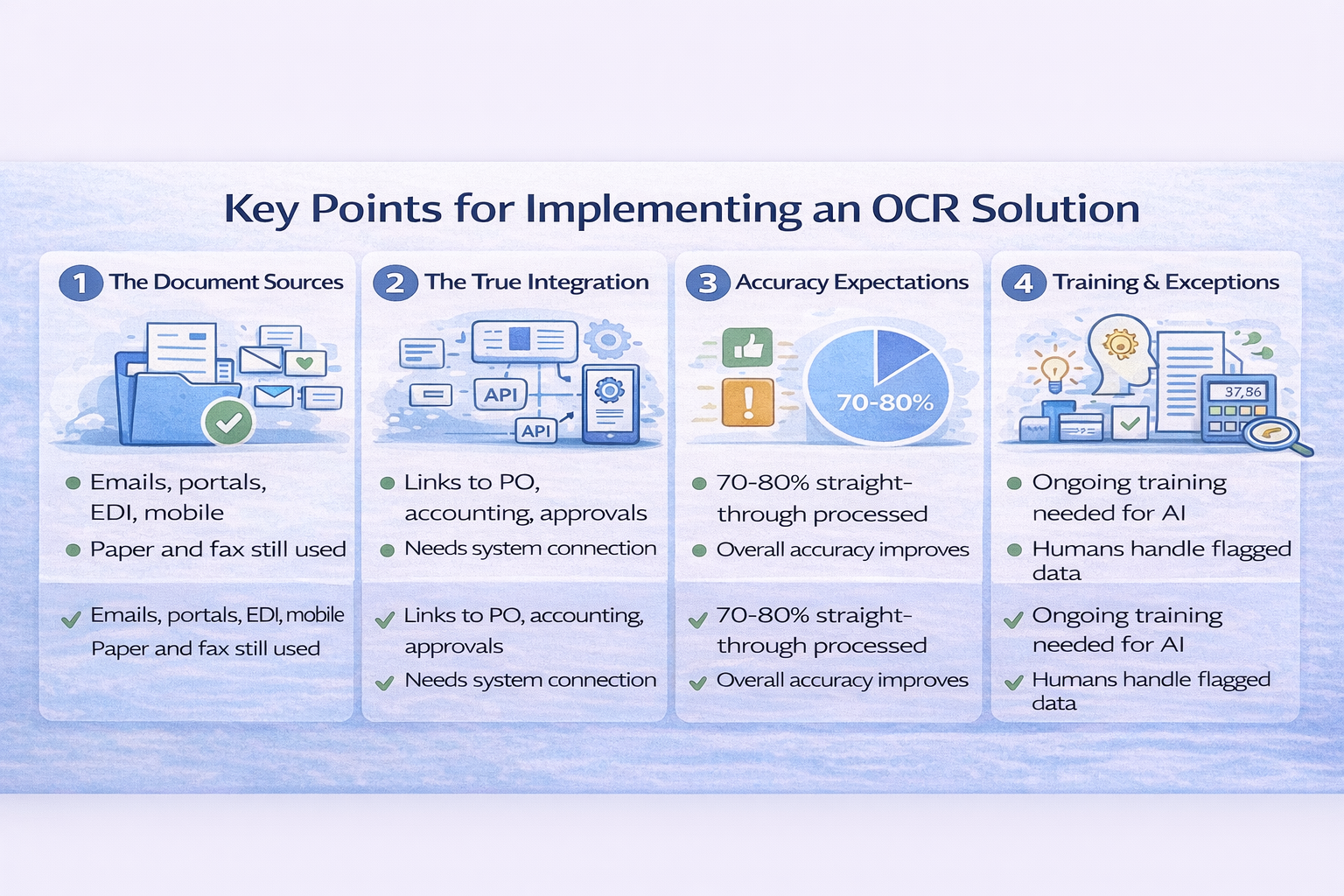
The Document Sources Question:
Before implementing OCR, understand where documents come from:
- Email: Most common, easiest to automate
- Supplier portals: May need API integration
- EDI: Structured data, different approach
- Paper/Fax: Still happens, needs scanning
- Mobile photos: Field staff taking pictures of delivery notes
Each source needs handling. A complete solution addresses all of them.
The Integration Reality:
OCR doesn’t work in isolation. It needs to connect to:
- Your PO system (to match invoices to orders)
- Your supplier database (to validate and match suppliers)
- Your accounting system (to create transactions)
- Your payment system (to schedule payments)
- Your approval workflows (for exceptions)
The OCR is actually the easy part. The integration is where the complexity lives.
Ready to let AI protect your procurement?
Contact Systematics Software Ltd today to explore how AI-powered solutions can revolutionise your operations and prepare you for the future of technology.
Nam aliquet ante porta, gravida elit, at fringilla felis suscipit.
What Accuracy Really Means:
Vendors often claim “99% accuracy.” But 99% of what?
- Characters? (Not useful – one wrong digit makes a price useless)
- Fields? (Better – but which fields matter most?)
- Documents? (Most useful – what percentage process with no human intervention?)
In reality:
- Well-formatted invoices: 85-95% fully automatic
- Poorly formatted: 60-75% automatic, rest need review
- Overall: Expect 70-80% straight-through processing
The key is continuous improvement – the system learns over time.
The Training Requirement:
Machine learning systems need training:
- Initial setup: System learns from sample documents
- Ongoing: System learns from corrections
- Supplier-specific: System learns each supplier’s format
This isn’t one-and-done. It’s continuous improvement. After six months, you should see better accuracy than month one.
The Exception Handling Reality:
Some things will always need human review:
- First invoice from a new supplier
- Significantly different prices from normal
- Poor quality scans
- Hand-written notes or alterations
- Complex credit notes
The goal isn’t zero human involvement – it’s focusing human attention on genuine exceptions, not routine data entry.
Ready to deploy AI protection across your procurement?
Contact Systematics Software Ltd today to explore how AI-powered solutions can revolutionise your operations and prepare you for the future of technology.
Nam aliquet ante porta, gravida elit, at fringilla felis suscipit.
What About Different Document Types:
Quotes/Proformas: Usually cleanest – suppliers want them to be clear. High accuracy possible.
Invoices: More variation. Some match POs perfectly, others have changes. Need good matching logic.
Delivery Notes: Often poor quality – paper, hand-written notes, stamps. Lower accuracy expected.
Credit Notes: Can be confusing – are amounts positive or negative? Need careful logic.
Statements: Summary documents. Different extraction approach needed.
Cost Considerations:
Let’s be realistic about costs:
- Technology: OCR processing costs per document
- Integration: Connecting to your systems (one-time but significant)
- Training: Initial setup and ongoing refinement
- Maintenance: Keeping up as suppliers change formats
But compare to:
- Current labour: Staff time doing manual entry
- Error costs: Duplicate payments, missed discounts, late payment fees
- Opportunity cost: What else could your team be doing?
For most businesses processing 200+ documents per month, ROI is clear within 6-12 months.
The Realistic Timeline:
I won’t give you specific weeks, but understand the sequence:
- Document current process and pain points
- Connect to one document source (usually email)
- Integrate with core systems
- Train on your documents
- Run parallel with manual process
- Expand to additional document types and sources
- Continuous refinement
It’s not instant. But you see benefits as you go, not just at the end.
Questions Worth Asking:
Before exploring OCR solutions:
- How many documents do you process per month?
- What’s your current cost per document? (Time × hourly rate)
- What percentage have errors that cause problems?
- How many suppliers do you have? (More = more format variation)
- What systems need to receive the extracted data?
- Can you quantify the cost of errors? (Duplicates, late payments, etc.)
The Human Factor:
Some staff will worry about job security. Others will be relieved to stop doing mind-numbing data entry. Address this honestly:
- Roles evolve, not disappear
- Focus shifts to exceptions and analysis
- More interesting work, less repetitive work
- Retraining opportunities
Change management matters as much as technology.
Curious about whether OCR makes sense for your volume and document types?
I’ve seen what works and what doesn’t across different business types. Happy to share perspectives based on your specific situation – no pressure, just information.
Book a conversation: https://calendly.com/jiteshlakhani
Or call: 0207 031 9810