Understanding OCR and AI for Purchase Orders – Beyond Manual Data Entry
Part 1: What OCR Actually Does (And Why It Matters)
The Data Entry Problem:
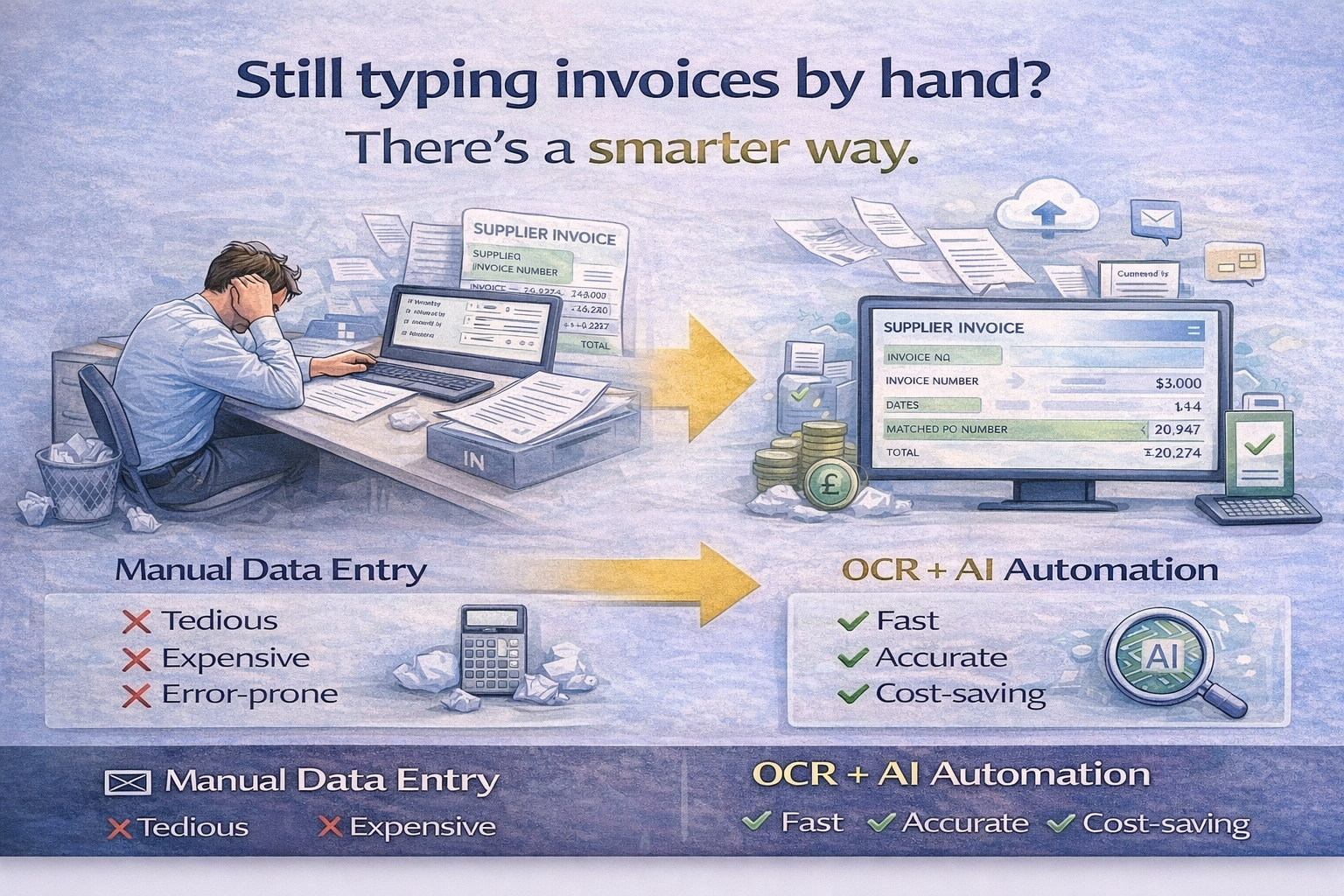
Let’s be honest about what’s happening in most businesses: someone receives a supplier quote or invoice by email. They open it. They manually type the supplier name, items, quantities, prices, and dates into your system. Then when the invoice arrives, someone else does it all again and tries to match the numbers.
It’s mind-numbing work. Typos happen. Numbers get transposed. Decimal points go in the wrong place. And it’s expensive – not just the labour cost, but the cost of errors.
What OCR Technology Actually Does:
OCR (Optical Character Recognition) reads documents and extracts text. But here’s what most people misunderstand: basic OCR just turns images into text. That’s not enough.
What you actually need is OCR combined with AI that understands context:
- This number is a price, not a quantity
- This is the total, not a line item
- This is the VAT amount
- This is the delivery date, not the invoice date
Modern systems use machine learning to understand document structure, even when every supplier uses a different format.
Ready to let AI protect your procurement?
Contact Systematics Software Ltd today to explore how AI-powered solutions can revolutionise your operations and prepare you for the future of technology.
Nam aliquet ante porta, gravida elit, at fringilla felis suscipit.
How It Actually Works in Practice:
Document Arrives: Email, scan, upload, EDI – doesn’t matter. The system ingests it.
Extraction: The system identifies and extracts:
- Supplier information
- Date
- Invoice or quote number
- Line items (description, quantity, unit price, total)
- Delivery terms
- Payment terms
- VAT breakdown
Validation: Here’s where intelligence matters:
- Does this supplier exist in your system?
- Do the calculations add up?
- Have we seen this invoice number before?
- Does the VAT calculation match the rates?
- Are prices consistent with previous orders?
Confidence Scoring: The system rates its confidence in each extracted field:
- High confidence → Processes automatically
- Medium confidence → Quick human check
- Low confidence → Human enters that specific field
The Duplicate Detection Challenge:
This is harder than it sounds. Suppliers sometimes:
- Send invoices multiple times
- Send corrected invoices with the same or different numbers
- Send invoices for partial deliveries
- Send credit notes that look like invoices
Good OCR systems catch most of this. Great systems learn your suppliers’ patterns.
Ready to deploy AI protection across your procurement?
Contact Systematics Software Ltd today to explore how AI-powered solutions can revolutionise your operations and prepare you for the future of technology.
Nam aliquet ante porta, gravida elit, at fringilla felis suscipit.
Why Format Variation is the Hard Part:
You might have 200 suppliers. Each has their own invoice template. Some use tables. Some use paragraphs. Some PDF invoices are actually images. Some are structured data.
The system needs to handle all of it. This is where machine learning becomes essential – the system learns to handle new formats by studying examples.
What This Means for Data Quality:
Manual data entry creates inconsistency:
- One person types “Ltd”, another types “Limited”
- Product codes get typos
- Numbers get transposed
- Fields get skipped
OCR with AI creates consistency:
- Supplier names match your master data
- Product codes are validated
- Numbers are mathematically correct
- All fields are captured, every time
This consistency is what makes AI applications possible later. Garbage in, garbage out – clean data in, intelligence out.
Curious about whether OCR makes sense for your volume and document types?
I’ve seen what works and what doesn’t across different business types. Happy to share perspectives based on your specific situation – no pressure, just information.
Book a conversation: https://calendly.com/jiteshlakhani
Or call: 0207 031 9810