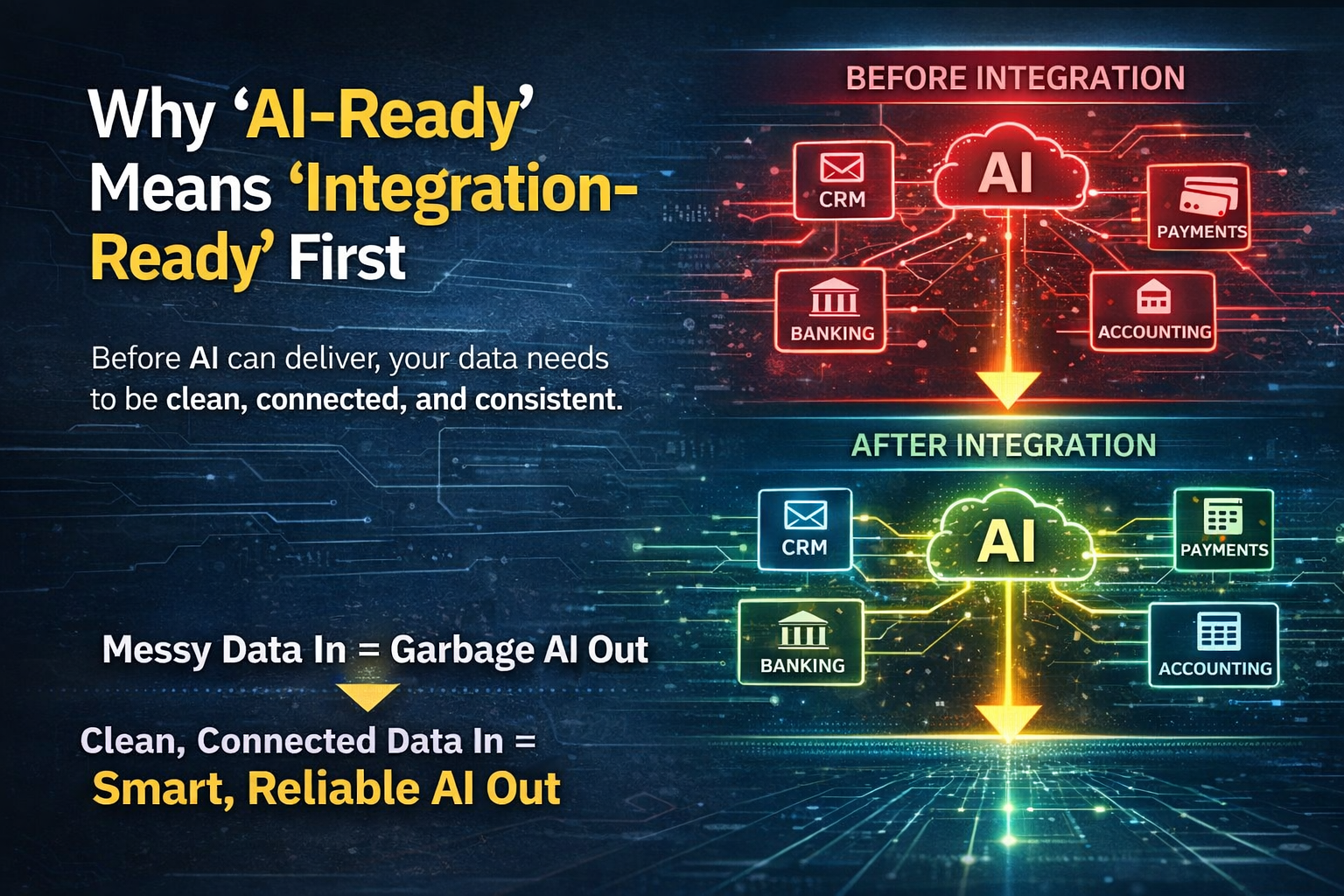
Why ‘AI-Ready’ Means ‘Integration-Ready’ First
The AI Hype Cycle Has a Secret Prerequisite
Everyone’s talking about AI. How it will revolutionise business. Automate everything. Predict the future. Transform your operations.
Your competitors are apparently using it. Your vendors all offer it. The pressure to “do something with AI” is intense.
But here’s what nobody wants to admit: Most businesses aren’t ready for AI. Not because they lack technical expertise. Because their data is a mess.
What “AI-Ready” Actually Means
AI doesn’t create insights from nothing. It identifies patterns in your data.
If your data is:
- Scattered across disconnected systems
- Manually entered with inconsistencies
- Duplicated with conflicting versions
- Incomplete or outdated
Then AI will:
- Identify patterns in chaos (meaningless)
- Make predictions based on errors (dangerous)
- Automate decisions using bad data (expensive)
- Generate confident-sounding nonsense (embarrassing)
“Garbage in, garbage out” isn’t just a saying. It’s the fundamental limitation of AI.
The Integration Prerequisite
Before AI can help you, your systems need to work together properly.
This means:
Single Source of Truth: Customer information changes once and updates everywhere. Not “eventually when someone remembers.” Immediately. Automatically.
Automated Data Flow: Data moves between systems without human intervention. No manual exports, imports, or transfers. No checking if it worked.
Consistent History: Historical data is clean and reliable. AI learns from patterns. If those patterns are corrupted by manual entry errors, AI learns the wrong lessons.
Connected Context: Systems share information so AI sees the complete picture. A customer isn’t five different records in five different systems. It’s one customer with complete, accessible history.
We build software that lets you enter data once and it updates all your business systems automatically. We also connect your existing systems so they share information with each other—payments, banking, accounting, CRM, the whole stack works together seamlessly.
This isn’t about AI. This is about creating the foundation AI requires.
Ready to let AI protect your procurement?
Contact Systematics Software Ltd today to explore how AI-powered solutions can revolutionise your operations and prepare you for the future of technology.
Nam aliquet ante porta, gravida elit, at fringilla felis suscipit.
Why Integration Must Come First
Scenario: AI-Powered Customer Predictions
You want AI to predict which customers are at risk of churning.
If Your Systems Are Connected: AI sees:
- Complete communication history (CRM)
- Payment patterns and delays (Accounting)
- Support ticket patterns (Support system)
- Usage patterns (Application logs)
- Banking relationship health (Banking platform)
AI can identify: “Customers with these combined patterns churn 73% of the time within 90 days.”
Valuable. Actionable. Profitable.
If Your Systems Are Disconnected: AI sees:
- Incomplete communication history (CRM only)
- Missing payment context
- No support pattern visibility
- No usage data
- No banking insights
AI identifies: “Customers who don’t respond to emails might be at risk.”
Obvious. Useless. Waste of money.
The Wrong Order (What Most Businesses Do)
- Get excited about AI
- Buy AI-powered tools
- Deploy on existing disconnected systems
- Get disappointing results
- Conclude “AI doesn’t work for our business”
The Right Order (What Actually Works)
- Connect your existing systems
- Let clean data flow automatically
- Eliminate manual entry errors
- Build consistent data history
- Then deploy AI on that foundation
In this order, AI delivers actual value.
What Integration Enables AI To Do
Predictive Cash Flow: When banking, accounting, CRM, and payment systems share data, AI can predict cash position 30-90 days out with remarkable accuracy. Factor in seasonality, payment patterns, pipeline probability. Transform cash management from reactive to strategic.
Intelligent Process Automation: Basic automation follows rigid rules. AI-powered automation makes contextual decisions based on complete information across systems. “Should this purchase order auto-approve?” AI considers budget, supplier history, order patterns, and current cash position.
Customer Intelligence: When all customer touchpoints share data, AI spots patterns you’d never see manually. Early warning signs of churn. Optimal timing for upsells. Hidden referral networks.
Anomaly Detection: AI can flag unusual patterns across connected systems. A transaction that looks normal in accounting might be suspicious when AI also sees CRM activity, payment history, and banking patterns. Fraud prevention that actually works.
But only with connected, clean data.
The Data Quality Multiplier
Integration doesn’t just connect systems. It improves data quality.
Automatic Validation: When systems share data, they validate each other. If a customer address updates in CRM, but accounting flags it as invalid, you catch errors immediately.
Elimination of Duplication: No more entering data five times. Enter once, flows everywhere. Error opportunities drop 80%+.
Enforced Consistency: Connected systems enforce data standards. You can’t have “ABC Ltd” in one system and “ABC Limited” in another. Integration forces resolution.
Complete Audit Trails: Every change tracked across all systems. When AI makes predictions based on historical patterns, you can verify the data quality of those patterns.
The Implementation Reality
You don’t need to integrate everything before starting with AI.
Phase 1: Connect Core Systems CRM, accounting, payment processing. Get clean data flowing between your most critical systems.
Phase 2: Deploy Simple AI Start with basic predictions on clean data. Payment timing predictions. Customer health scores. Simple but valuable.
Phase 3: Expand Integration Connect additional systems. Banking, inventory, support, operations.
Phase 4: Advanced AI Layer in sophisticated AI capabilities now that you have comprehensive, clean data.
Each phase delivers value. Each phase builds on the previous one.
Ready to deploy AI protection across your procurement?
Contact Systematics Software Ltd today to explore how AI-powered solutions can revolutionise your operations and prepare you for the future of technology.
Nam aliquet ante porta, gravida elit, at fringilla felis suscipit.
The Cost of Skipping Integration
Many businesses try to skip straight to AI:
Year 1:
- £50,000 spent on AI-powered tools
- Disappointing results due to bad data
- Frustrated team and sceptical leadership
Year 2:
- Another £50,000 trying different AI tools
- Same problems (because the data is still a mess)
- Growing belief that “AI doesn’t work for us”
Year 3:
- Finally address the underlying data integration problems
- Start seeing results
- Realise we should have done this first
That’s £100,000 and two years wasted.
The Cost of Getting It Right
Year 1:
- £30,000-£50,000 on system integration
- Immediate efficiency gains from automated data flow
- Foundation built for future AI capabilities
- Clean data accumulating
Year 2:
- £20,000-£30,000 on AI tools (now properly founded)
- Strong results because data is clean
- Continued efficiency gains from integration
- Competitive advantage expanding
Same total investment. Dramatically better results.
The Question Isn’t Whether AI Will Transform Your Business
The question is whether your data is ready to let it.
Every day you delay integration:
- Bad data accumulates
- Manual entry errors compound
- AI remains expensive disappointment
- Competitors with clean data pull ahead
Ready to build the data foundation that makes AI actually work?
Let’s discuss how integration-first approaches transform AI from expensive experiment to genuine business advantage.
📅 Book a conversation: https://calendly.com/jiteshlakhani
📞 Call directly: 0207 031 9810